


[ad_1]
When Egyptian artist Ramy Essam describes Metgharabiin (Outsiders), his new album, launched on Friday, he talks of rage, nostalgia, longing and sorrow.
It chronicles a life in exile laced with bouts of loneliness and hope. And in gentle of every little thing that Essam has been by over the previous few years, it marks a departure from his earlier work.
“By the years, my music was at all times centred round customary rock music blended with Egyptian tradition – Egyptian music tradition and North African music tradition,” Essam defined to Al Jazeera.
“However this album may be very distinctive and totally different. It has a really stand-alone sound, [unlike] something I’ve achieved.”
The work was a product of COVID-19 when Essam misplaced his skill to tour and was locked at dwelling for a substantial period of time, compelled to reckon and reconcile together with his personal expertise residing in exile since 2014.
He contributed to the manufacturing of one in every of his albums for the primary time and labored remotely with Stockholm-based producer Johan Carberry. Neither consciously meant to create the album’s distinct digital sound.
As an alternative, it manifested organically as Essam was toying round together with his music manufacturing software program, sampling tunes and creating demos that birthed a fusion of his assertion conventional rock composition and the highly effective, industrial digital music heard all through the entire 12 featured songs.
His artistic juices flowing, Essam discovered that probably the most difficult a part of ending the album was selecting which songs from his wealthy repertoire would make the lower.
“I’ve possibly like 20 extra songs or so in the identical course [of this current album] as a result of this has been my life for 9 years,” he informed Al Jazeera laughing.
Metgharabiin (Outsiders), in line with Essam, will not be solely political and revolutionary but additionally tells his story and that of a number of individuals whose destiny has been equally tainted by exile.
In January 2018, Essam’s Egyptian passport was revoked by the federal government, leaving him in paperless limbo, unable to journey. It’s an occasion that has since formed his artwork.
Leaving the homeland
By the center of 2013, Essam was virtually utterly restricted from having the ability to carry out in Egypt, and his music was largely censored from state-controlled media retailers.
Whereas his guitar was not bodily stripped away from him and his highly effective voice may nonetheless rile up Cairo’s Tahrir Sq., the revolution was taking a stark flip from its eruption in January 2011 and as an alternative went by a coup, bringing about army rule.
At this level, journalists, activists, artists and civilians calling for the ouster of the federal government had been being focused, arrested and thrown in jail. Essam didn’t escape the beatings or the arrests, however he finally made it out of Egypt in 2014 after he was provided a two-year artist residency within the Swedish metropolis of Malmo.
His tune Irhal was for a very long time the anthem of the 2011 revolution, which overthrew President Hosni Mubarak – a tune that impressed thousands and thousands of individuals swelling Tahrir Sq. to sing alongside to the lyrics in unison.
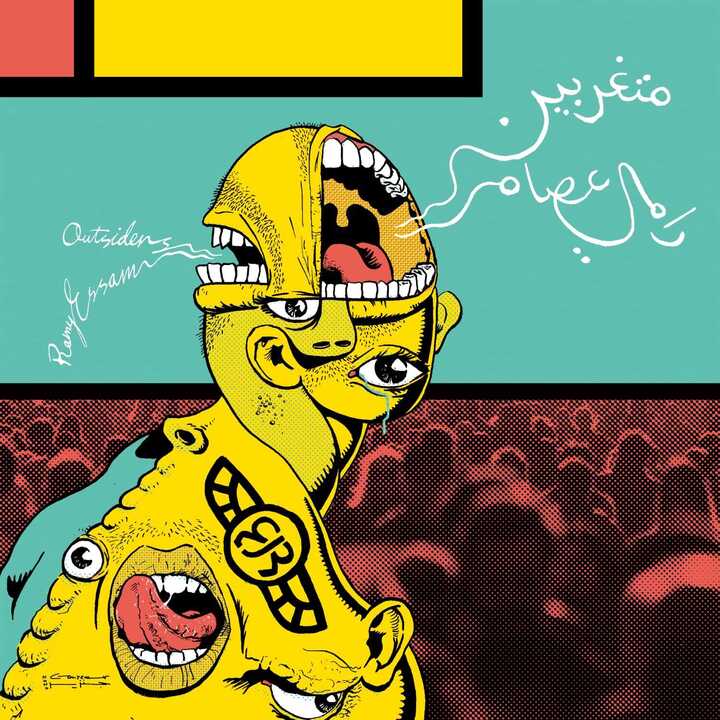
Consistent with this theme of exile, Essam tapped Ganzeer (a pseudonym, that means “chain”), the prolific Egyptian road artist, to work on the duvet artwork for this album. Recognized for his murals of protesters who perished through the Tahrir Sq. rebellion, Ganzeer was compelled to flee Egypt within the aftermath of the revolution after his artwork angered the regime.
Distinguished poets and soulful tracks
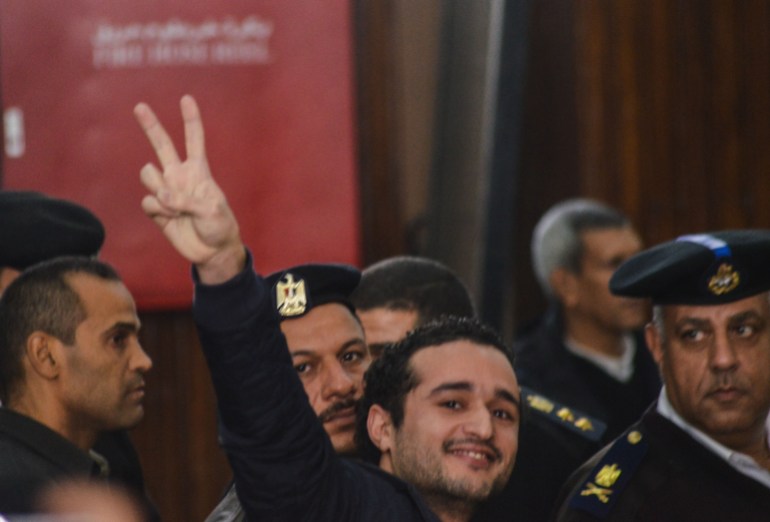
The album doesn’t fail to make highly effective statements, particularly the tracks El Amiis El Karooh (The Flannel Shirt) and Lagl Tentesri (For You to Win), written from behind bars by the activists Galal el-Behairy and Ahmed Douma, respectively.
“Lagl Tentesri (For You to Win) is so highly effective. It’s Ahmed Douma’s expertise of being in jail for eight years,” Essam stated.
Douma was arrested in 2013 in relation to demonstrations towards the criminalisation of public protests. He was first sentenced to 3 years in jail, however throughout his time in detention, he was charged in a second investigation into 2011 protests held on the cupboard headquarters, and his sentence was elevated.
The tune was penned on the tenth anniversary of the revolution, and Essam stated, “You’ll be able to see his ache and anger in that we nonetheless didn’t win the combat” even after all of the sacrifices that he and fellow Egyptians made.
Concurrently, it describes hopefulness and the necessity to “nonetheless keep on the combat, and never simply by way of revolution, however it displays on something in our day by day lives”.
The ache, loss and unhappiness of being away out of your individuals and family members is elucidated in El Amiis El Karooh by el-Behairy, an Egyptian poet, lyricist and activist who has been in detention in Tora Jail in Cairo since March 2018 on a variety of fees, together with “terrorist” affiliation, dissemination of false information, abuse of social media networks, blasphemy, contempt of faith and insulting the army.
The title observe, although, is wholly Essam’s personal creation.
“Metgharabiin, I bear in mind precisely how I wrote this observe,” Essam stated, with a wistful smile, twirling his lengthy curls.
“The thought of the tune began to develop between 2013 and 2014, however then I wrote it within the final week I used to be in Egypt,” he stated.
“I wrote it as a result of at the moment I used to be banned. I used to be banned from performing. My music was banned from in all places [in Egypt]. The revolution was struggling a lot, and it was the primary time we couldn’t protest, we couldn’t exit to the streets. We misplaced the sq., and everybody was blaming the revolution [for the country’s failures].”
Written between Egypt and Sweden, the primary few traces of Metgharabiin speaks of “strangers in our lands/years come and go/the world is towards us” and describes the sensation of being an outsider in Essam’s personal homeland. The remainder of the lyrics had been accomplished in Sweden, the place Essam additionally discovered that he was an outsider. His album, he stated, is basically for many who really feel the identical approach.
“If someone desires to dwell Ramy Essam’s expertise of being an outsider, you’ll be able to take heed to this album,” he stated. “I would like everybody that’s feeling like an outsider to not really feel alone, that we’re collectively, and to search out unity and to search out peace.”
Disrupting dictatorship
Commenting on the oppressive guidelines of censorship in Egypt, Essam believes artwork has the ability to disrupt any dictatorship, therefore the regime’s concern of artists and their creations.
“It’s a pressure that they concern as a result of they’ve zero management over it. As quickly as a tune is launched and one other particular person hears the tune, they’ll carry it and cross it to the subsequent one. It’s over [for the government],” he elaborated.
Essam stated he has been a sufferer of cyberattacks after the discharge of some closely politicised and anti-regime songs. His attain and streaming numbers additionally declined, and it appeared that curiosity in his music had dropped.
Nevertheless it seems as if his music is being shared, simply by extra clandestine strategies.
“Within the final couple of years, you form of really feel helpless about [the numbers] since you’re combating towards the regime with all their cyberarmies,” Essam stated. “[But] I came upon that individuals in Egypt, … they share [my music] between one another by WhatsApp, by Telegram, as a result of it’s not that protected for individuals to share it publicly.”
“No regrets”

Regardless of the exile, the loneliness and every little thing else that accompanies it, Essam stated his motivation is sort of easy. “The one factor that issues is the documentation of the period in a type of political artwork,” he stated, explaining that he hopes this artwork will defy makes an attempt by the highly effective to jot down their very own narrative.
The significance of the duty to supply this artwork, to behave because the archivist for one’s time, is one thing he hopes to impress on the subsequent technology, which he believes is on observe to succeed the place he couldn’t.
Nevertheless, he admitted that the battle is ongoing, and that because the revolution, issues in Egypt have deteriorated. “All the things is far worse,” he stated, “and that’s why many individuals curse the revolution and curse the technology that made the revolution.”
However change at all times comes at a price.
“I’m right here now due to one single choice of me going out to affix the Egyptian revolution,” Essam stated, reflecting on the difficulties of the previous decade.
“It was additionally a journey that was stuffed with magnificence and moments of freedom I’ve by no means felt earlier than. If I’m going again to [that moment] one million instances, I’ll exit to the streets once more. That can by no means take away from the hardships and struggles, however no, no regrets.”
[ad_2]

